Visit our Airfix Now page for the latest Airfix content on SMN
Our first set of Battleships have docked, welcoming them to the 2026 Airfix range!
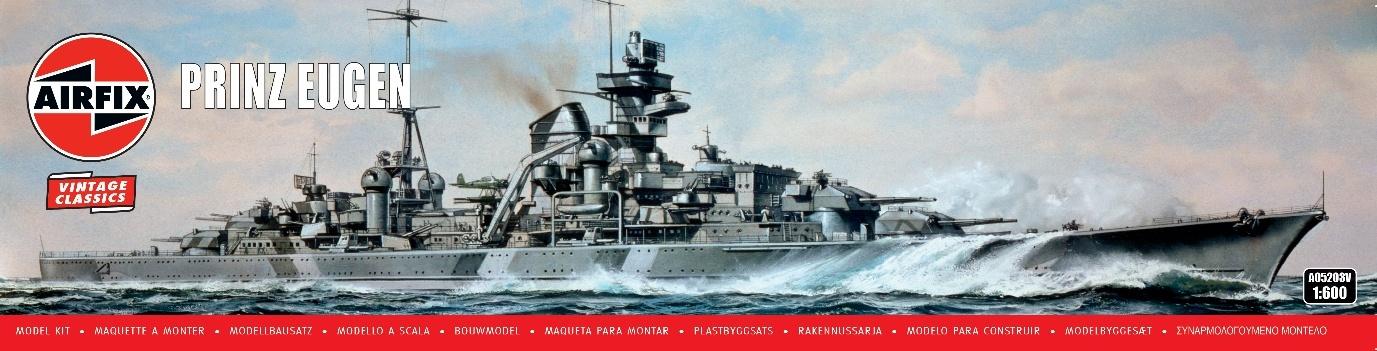
Prinz Eugen
A battleship with a rich history before, during and after WWII, the 1:600 scale Prinz Eugen makes a comeback to the Airfix range in Vintage Classic form. With the tooling first created in 1974 and the iconic pack illustration on the box front created by Roy Cross in 1974. Overall, this skill level 3 battleship kit contains a total of 151 parts and once built, the kit measures an overall length of 354mm and a width of 36mm.
Prinz Eugen was sent into the North Atlantic alongside the Bismarck to target convoys heading to Great Britain. During the Denmark Strait battle, she inflicted damage on both HMS Hood (later sunk by Bismarck) and HMS Prince of Wales, before making her way to Brest in occupied France.
The heavy cruiser Prinz Eugen was named after Prince Eugene of Savoy, an 18th-century Austrian general. As part of the Admiral Hipper-class heavy cruisers, she was a formidable ship equipped with eight 20.3cm guns in four twin turrets, twelve 10.5cm anti-aircraft guns, and twelve 53.3cm torpedo tubes. Commissioned in August 1940, Prinz Eugen became one of the Kriegsmarine’s most effective surface raiders.
More information and to buy this kit
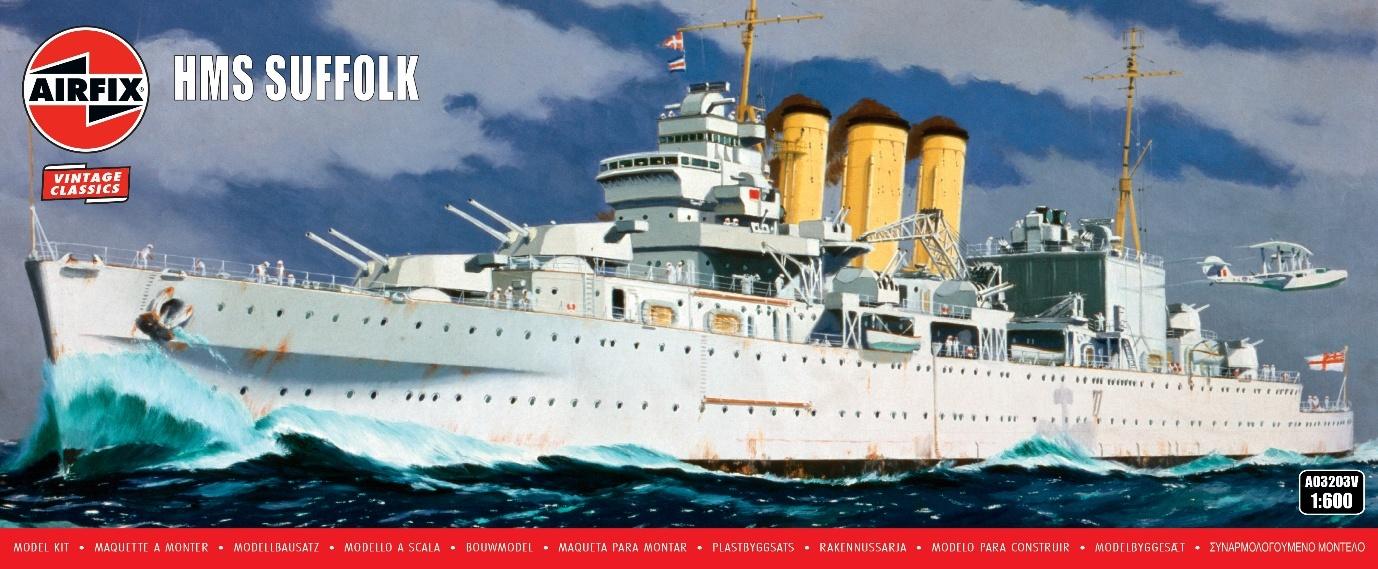
HMS Suffolk
Ranked at skill level 2, the 1:600 scale HMS Suffolk cruises back to the Airfix range in Vintage Classic form. With the tooling first created in 1964 and the iconic pack illustration on the box front created by W. Howard Jarvis in 1964. Overall, the kit contains a total of 128 parts and once built, the ship measures an overall length of 320mm and a width of 32mm.
HMS Suffolk was a distinguished County-class heavy cruiser in the Royal Navy during the Second World War. In May 1941, she was instrumental in the Battle of the Denmark Strait and the eventual sinking of the German battleship Bismarck. Suffolk engaged the enemy battleship twice and, with her advanced radar systems, successfully tracked the Bismarck through the Denmark Strait’s challenging waters. This vital surveillance allowed Suffolk to maintain contact with the enemy, providing crucial intelligence that enabled other Royal Navy units to intercept Bismarck.