Short Feature Article with Rob Ruscoe
Just before we get started, here’s a look at how it all turned out…
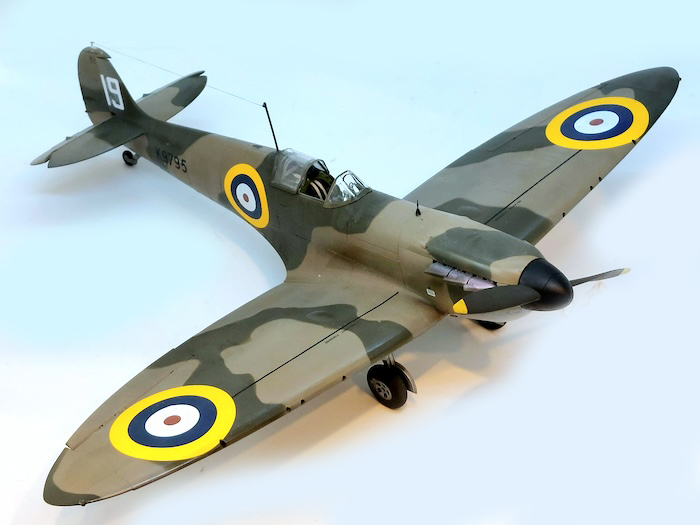
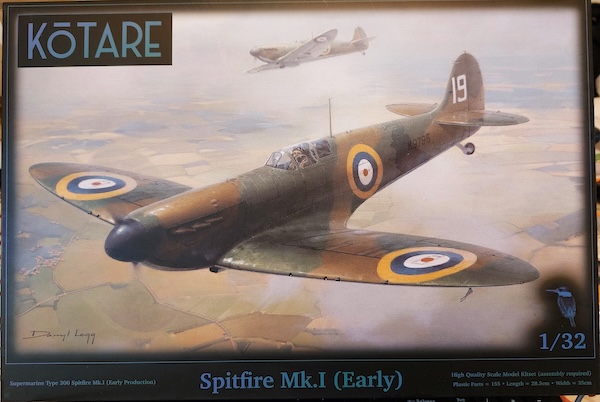
Having already built KoTare’s Spitfire Ia (Mid Production) [see here], I decided to complete the recently released early production aircraft. This was for two reasons. Firstly, I thoroughly enjoyed the first build and wanted the pleasure of putting another one together. Secondly, I love the look of these ‘baby’ Spitfires.
Having written a full article on the previous build, I don’t intend to repeat the full construction here. Instead I will outline the differences between the two marks and how that affects the build.
Brief History
Everyone with even a slight interest in aviation will be familiar with the story of Reginald Mitchell and the design of the Spitfire. The prototype, K5054, made its first flight at Eastleigh Aerodrome, Southampton on 5th March 1936. This first aircraft was very much constructed by hand with many individual panels which gave it a ‘clinker’ built appearance. The aircraft was, however, completely flush riveted. Initially, the top speed of 330mph, similar to the much less refined Hawker Hurricane, was disappointing but after a coarser pitch propeller was fitted, this was raised to 348mph before the aircraft went to A&AEE for acceptance trials. After some minor modifications, the Air Ministry placed an order for 310 Spitfires.
Although full-scale production was supposed to begin immediately, problems with mass producing this complicated airframe took quite some time to overcome and at one period the aircraft was almost cancelled. It wasn’t until mid-1938 that the first production Spitfire, K9787, rolled off the production line.
The production aircraft differed from the prototype in having a slightly more powerful RR Merlin II engine giving 1030hp at just over 10,000ft. Experiments had also shown that using domed rivets on most of the rear fuselage didn’t incur a large penalty in top speed but did mean a significant reduction in production man hours. The single stage flap angle was also increased to provide more drag to reduce landing distances whilst the two small wheel well doors, which completely covered the retracted landing gear on the prototype, had proved to be vulnerable and were removed. A cockpit undercarriage position indicator had also been added to augment the mechanical indicators although the simple, hand-operated, hydraulic system of the prototype was retained. At this time of course, there was no armour plate behind the pilot or an armoured glass windscreen fitted. These came later along with a bulged cockpit hood to give the pilot more headroom. Important later modifications included a change from the wooden, fixed pitch ‘Watts’ propeller to the two-pitch De Havilland metal three-blader. This gave the aircraft a much improved take-off and combat performance. Along with the pilot armour, later aircraft were also given an armoured fuel tank cover. These early aircraft were fitted with the notoriously unreliable TR9D High Frequency Radio Telephone system. This required the long aerial wire running from mast to fin which is distinctive of early Spitfires. With the introduction of VHF R/T sets in mid-1940, this wire could then be deleted as the mast itself was now the aerial. Another addition was ‘Pipsqueak’. This was an early form of the modern transponder, also called Identification Friend or Foe or IFF, which marked the aircraft as friendly on the radar screens. The introduction of gun heating was also found to be necessary.
The first production aircraft were introduced into service by 19 Squadron at Duxford in August 1938.