Full Review with Rob Ruscoe
Just before we get started, here’s a look at how it all turned out…
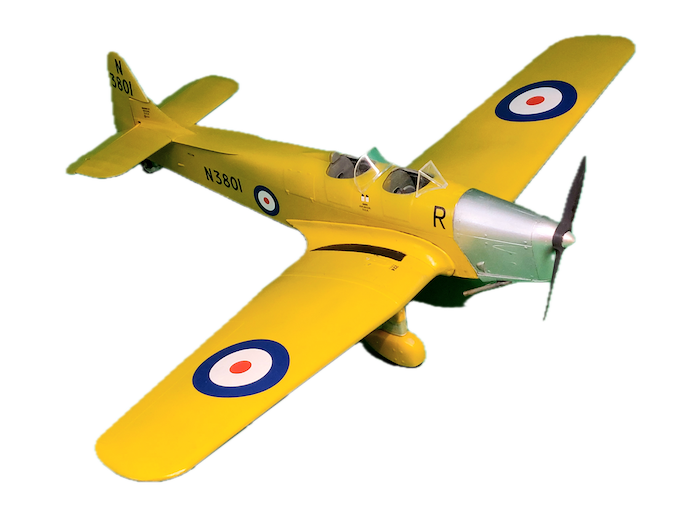
Who would have ever thought that we would see lesser-known aircraft such as the Magister in 32nd scale. Thanks to Ukrainian company Mikro Mir we now can!
The Magister has always been out-shadowed by the more numerous Tiger Moth but, in many respects, it was more ideal for training pilots going on to the modern monoplane fighters. It was in fact, the first monoplane trainer to enter RAF service. The aircraft was substantially faster than the Tiger Moth and had much better harmonisation of the controls. It also had the advantage of being capable of being flown solo from either seat – usually from the front initially and then from the rear which emulated the single seat fighters the pupil might go on to fly. The magister was also a much better aerobatic mount – the Tiger being quite limited in this respect.
The Magister was designed by G.H.Miles, the brother of the famous F.G.Miles, and was based on the existing Miles Hawk Trainer which was in service in small numbers. The aircraft was constructed of spruce with a plywood covering which made for a very smooth airframe. Powered by a De Havilland Gypsy Major I engine of 130HP it had a maximum speed of 142 mph and a range of 367 miles at 122 mph. With its large split flaps, the stalling speed was only 43 mph. During initial testing, it was found that the aircraft proved to be reluctant to recover from spins with the C of G near the aft limit. This was improved with the raising of the tail-plane by three inches and the addition of anti-spin strakes, but was still not acceptable for service use. The problem was eventually fully solved by fitting a rudder of broader chord.
The prototype made its first flight on 20th March 1937 and entered service with the RAF and Fleet Air Arm the following year. A total of 1203 aircraft were built (plus another 100 licence built in Turkey). Being constructed of wood held together by organic casein glues which deteriorate with time, not many Maggies survived for long after the war. Only two examples remained on the register when, in the 1970s, the Shuttleworth Collection decided to try and acquire one of these supposedly airworthy examples. On examining the one aircraft that was for sale, G-AJRS, ex RAF P6382, was flown to Old Warden for a full inspection. Unfortunately it was found that the aircraft needed a full ground-up restoration. This was carried out over a lengthy period before the aircraft took its place in the collection of airworthy classics. Since then an additional number of flying examples have been restored to grace the skies.
The Kit
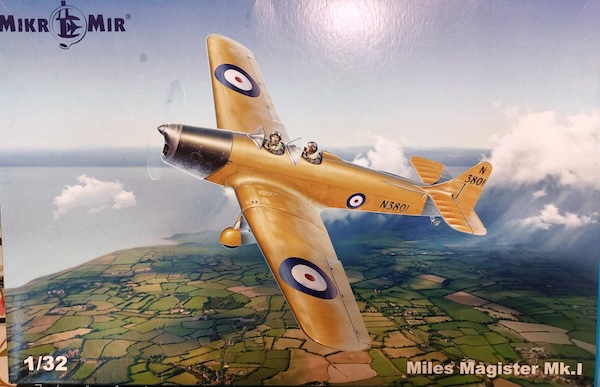
This comes in a sturdy top-opening box which has some nice box-art of a Magister flying over a typical English coastal landscape. The student looks as if he is giving the instructor a good listening to!
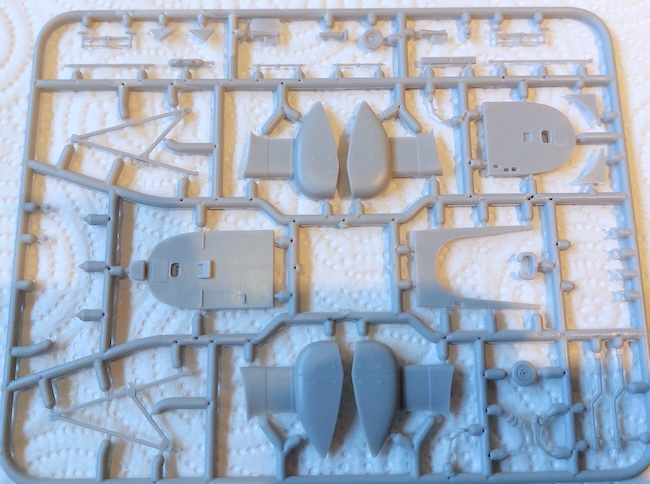
Inside are six sprues of styrene which exhibit some nice detail but have some flash typical of a low pressure moulded kit. The sprue gates, however, are commendably small.
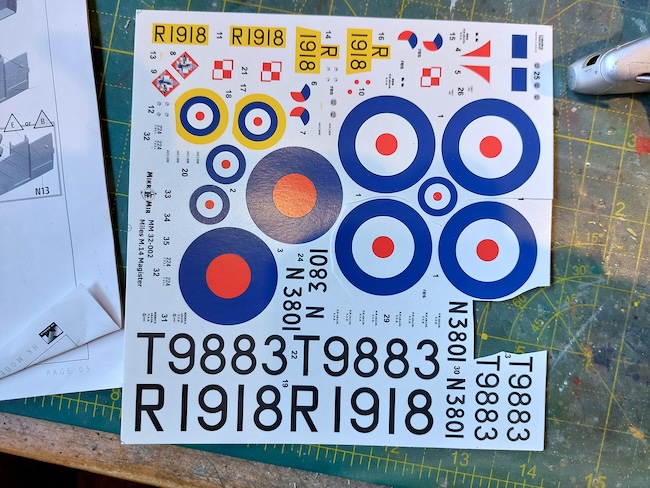
There are some finely detailed resin components that will make up the Gypsy engine, and a single PE fret containing seatbelts, instrument panels, and the like. A decal sheet contains markings for three aircraft – two being dark earth and dark green camouflage over trainer yellow, and the third a pre-war all over yellow scheme.
The kit also has a set of both internal and external masks for the two windscreens. The instructions and marking diagram are on three folded A4 sheets and are reasonably clear. So everything you need is in the box – pity some mainstream manufacturers can’t be bothered to do this!