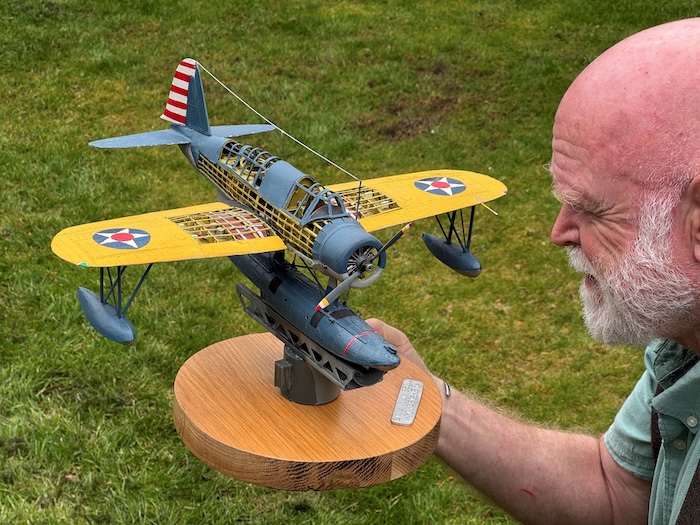
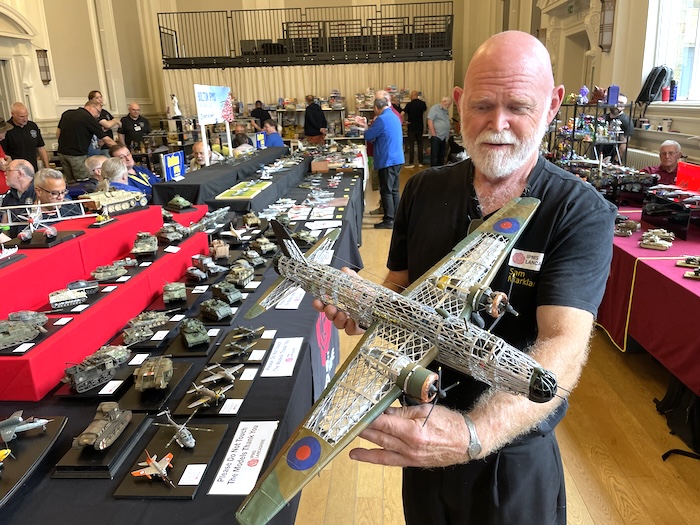
(Photos: Sam with his scratchbuilt Vought Kingfisher and Vickers Wellington…)
Scratch Builds & Specials
Models by Sam Markland
Photography and article by: Sam Markland and David Muscroft
A note from Geoff C…
I really hope that many of you will read and understand Sam’s approach here to scratchbuilding. He provides many ideas that can be useful for more mainstream builds, especially if you are thinking of adapting or adding to what’s provided in the kit box. Accessories that you want to include may also not be available as aftermarket sets and Sam provides some great ideas for items that might help. Using your imagination and creativity can pay dividends for all of us, whatever scale modelling we are interested in.
Regular contributor David Muscroft has added an additional modelling theme to his experience. He introduced himself to Sam Markland at IPMS Skipton (UK) show after being taken aback by his 1:32 scale ‘see through’ Wellington model which took up a lot of space on his model clubs’ table. Being something of a modelling ‘contrarian’ and while not being a scratch builder, David hardly ever models SOOB, he was immediately drawn to Sam’s work. He comments further ; “The total contrast to the rest of what was on show at Skipton IPMS immediately exerted a huge pull on my attention. While not being at all blasé about the variety and excellence we can always find at shows, Sam’s model stood out from a distance and was very intriguing at a closer look”.
David’s enquiries revealed a whole new world of model making, which then led on to lots of further conversations, photography sessions and endless discussions on aviation and historical subjects.
“Nothing is as it seems….. I turn up-cycled junk and a conglomeration of other people’s rubbish into an aircraft model”
So says Lancashire modeller Sam, a retired policeman.
Sam said that he was just about to embark on his next project, a 1:24 scale Vought Kingfisher floatplane (which coincidentally David was also building but in a much less impressive, and almost SOOB 1:48 scale). So the plan was hatched to document the build, Sam’s work and modelling skills.
Sam goes on to say:
“It crossed my mind (a short journey) that your readers may be interested in a quick description of the parameters I stick to when building my models; there will be some who view your site who may say to themselves ‘why doesn’t he use a 3D printer?’ Or ‘that’s available as an after market set’, so to set the scene, so to speak, here is my philosophy…
No item used in the construction of my models was ever intended by its original manufacturer to be part of a model. Everything apart from glue (super glue and PVA) is sourced at no cost from all corners of the ‘waste’ environment and then repurposed to represent the parts required to build the model.
The models are not exact replicas in miniature but artistic representations and as such there is a latitude of accuracy afforded to this mode of construction. This is not an excuse but a dividing principal between the ‘commercial kit’ and this form of model making which must be accepted as both styles of construction have their merits but are not comparable; much as a portrait oil painting produces a recognisable image as would a photograph; neither can be judged together as the method of arriving at the finished article bear no resemblance to one another. If you intend to build in this style it is no use to choose a subject and then go looking for material. One has to collect likely sources of ‘junk’ disassemble it and store it in boxes divided into categories, wood, aluminium, foils, circuit boards, bamboo, wire, plastic, knitting needles etc, etc ,etc. one can then choose suitable items from which to make the parts required.
If you scratch build, you take on a number of functions which the commercial kit manufacturer provides ready made for you and as such denies you the enjoyment/ satisfaction of carrying out these functions for yourself in your own style in an order of your choice with parts of your own sourcing/adaptation. This method will ensure your model is unique to you and the world and so you will never win a competition with one as no one knows how you did it.”
He made ‘everything Airfix’ as a boy (more recently reaching a good level of proficiency on commercial plastic kits) and later in life returned to building ships out of wood and now has a shed full of large wooden model vessels. He was originally a member of North West Model Shipwrights when all models were scratch built to museum standard in all subjects. In 2017, he picked up a copy of Windsock’s ‘AD flying boat’ with full plans inside. It was basically a boat hull with wings so he set to, progressed onto skeletal WW1 aircraft and then to WW2 aircraft. The rest is history.
Sam produces see-through models to better display their fascinating interior details, including a Sunderland which is the only aircraft he has built which is complete with a replica crew toilet and loo roll plus a cooker!
His models comprise lots of individual assemblies which are then put together to make the whole, and are finished off with hand painting using salvaged paint from recycling centres (hence his colours often do not accurately reflect the real life originals). The aircraft national markings are hand masked and painted. He only uses salvaged paint…… and consequently doesn’t mind if the resulting colours don’t accurately reflect the original.
Salvage also extends to his equipment. His home-made or salvaged tools include a Victorian wooden paper slicer which can cut wood veneer strips down to as little as 1mm wide (used as ship deck planking) and a home made multi sanding tool powered by a washing machine motor which drives an old angle grinder, slotting saw, belt sander and drum sander.
He rounds off his involvement in modelling as a mentor for the Models For Heroes charity.