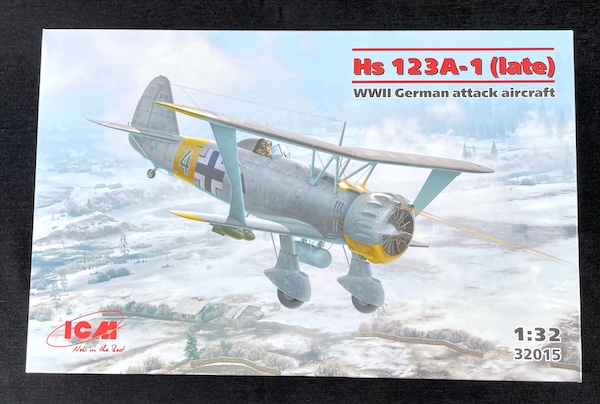
Full Review with Rob Ruscoe
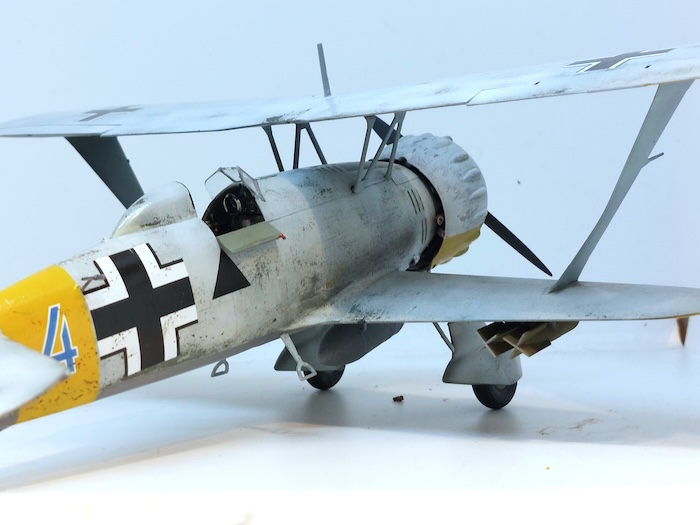
Just before we get started, here’s a look at how it all turned out…
Brief history
The Hs123 began development in 1933 in response to a request for a single-seat dive bomber and ground attack aircraft. Henschel decided on an all-metal sesquiplane design, this being a biplane layout with the small lower wing being used as much for structural purposes as lift contribution. All flight loads were carried by the large interplane struts and the cabane struts. This meant that no external bracing wires were required and hence drag was reduced to a minimum. The design entered service with the Luftwaffe in 1936 and quickly replaced the Heinkel He50 but was considered an interim aircraft until the arrival of the Ju87.
In 1938 a number of Hs123s were sent to serve with the Condor Legion supporting General Franco’s Nationalist forces in the Spanish Civil war. The aircraft performed well enough for production to continue. The 123 next saw action in the Polish campaign and the invasions of the Netherlands, Belgium and France. Next, the aircraft was used in Operation Barbarossa – the invasion of the Soviet Union and proved to be robust, serviceable and effective in combat. Although production of the aircraft ended late in 1938, it continued in front line service until lack of airframes and spares caused its retirement in 1944.
The A-1 version of the aircraft was powered by a BMW 132D nine cylinder radial engine of 880HP driving a two-bladed variable pitch metal propeller. Maximum speed was 212MPH at 3,900ft and combat range was 460NM with a single drop tank. Armament consisted of two 7.92mm MG17 machine guns with 400rpg and up to 1000lbs of bombs could be carried.
There are no known intact original survivors of the Hs123 extant although some remains and components exist in collections and museums.
The Kit…
The Henschel 123 has been well served in the smaller scales for quite a number of years. In 2017, Gaspatch models produced a very nice 1:48 Hs123B-1. This was a well detailed kit which goes together extremely well as evidenced by Geoff’s lovely model in SMN. I was interested to see how ICM’s 1:32 kit compared to the Gaspatch tooling. Geoff has also completed a Here Now In-Box Browse where you can take a good look at the kit as it comes in the box.
ICM produced the first boxing of this kit last year and this was followed by an early version of a Legion Condor aircraft and the subject of this build which is a late Eastern Front aircraft.
Opening the sturdy box revealed eight sprues of grey styrene, a small clear sprue (windscreen and nav lights) and a single decal sheet with markings for four aircraft. Detail is crisp and panel lines looked nicely done. There is no rivet detail but as this aircraft was flush riveted, this is acceptable omission to me. The instructions are reasonably clear and contain 71 stages of construction.
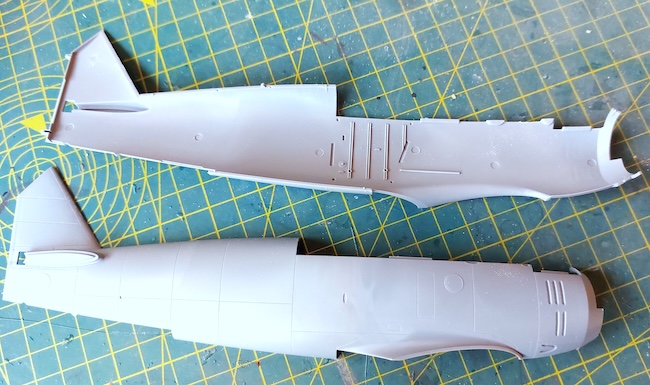
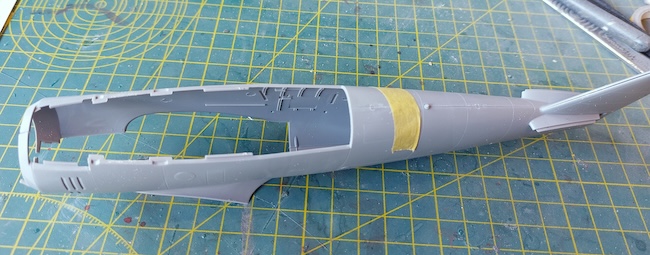
(Photos: Fuselage halves test fitted together already gives an impression of how the kit is going to go together)