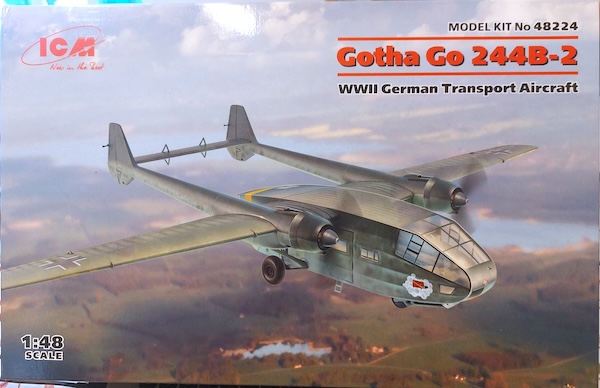
Full Review with Rob Ruscoe
In late 1939, the Reichsluftfahrtministerium (RLM) issued a requirement for a heavy transport glider, capable of carrying 20 fully equipped troops, to replace the DFS 230 then in service. The Germans were the first to utilise gliders to land concentrations of troops on the battlefield rather than paratroops having to waste time regrouping after a scattered drop. The Go 242 was designed as a high wing, twin boom aircraft with a square-section fuselage formed of steel tubing covered with fabric. Cargo versions of the glider featured a hinged rear fuselage and loading ramp. Two prototypes flew in 1941 with the flight characteristics being superior to the DFS 230. Although a total of 1528 gliders were built, they saw very little combat service.
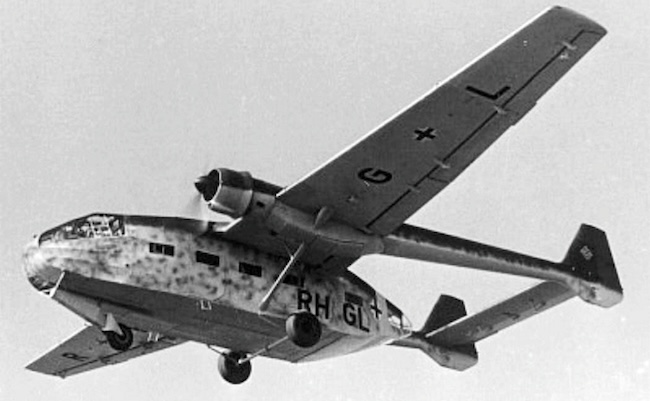
(Photo: A German Gotha Go 244 (RH+GL) in flight. The Go 244 was a the powered version of the Gotha Go 242 glider fitted with Gnôme-Rhône 14.M engines. The picture was issued by the RAF in 1945. Courtesy IWN Archive)
Studies into a powered version of the Go 242 had commenced relatively early in the glider’s development and following the fall of France in June 1940, the Germans capture of a large number of Gnome Rhone 14M radial engines accelerated the design of the Go 244. Two of these engines were mounted on forward extensions of the tail booms and fuel tanks were installed in the inboard wing sections. Interestingly, the 14M radials came in two versions which rotated in opposite directions and one each of these were utilised in the 244 to cancel torque effects.
The first Go 244s were delivered to units based in Crete in March 1942 and the type would also see action in both North Africa and on the Eastern Front. The unimpressive performance of the French engines meant the aircraft was slow and lacked range which severely limited its operational effectiveness. Consequently production was curtailed after only a very limited production run – probably about 150 aircraft although exact numbers are not known. The much larger powered glider in the form of the Me 323 Gigant, also utilising Gnome Rhone engines – six of them in this case, was favoured over the Gotha design.
The ICM Kit
This arrived in ICM’s usual sturdy box which has some nice box art depicting the aircraft in flight. Although the box is big, it is packed with styrene. A total of thirteen sprues of the usual light grey plastic exhibits some very nice moulded detail – the fabric effect being particularly nice. All these are individually bagged. Another sprue contains the extensive glazing present on the aircraft. I must admit that a flutter of apprehension was felt here at the thought of masking and attaching all these clear parts, they can be the making or breaking of a model after all! There is a small fret of PE containing the pilot’s harnesses and a nice looking decal sheet. The instructions are the usual ICM style with clear diagrams and colour call outs. Two aircraft options are provided albeit with identical colours – the difference is solely in the markings.
Join the SMN Modelling Community Today
For just £1.50/month (£18/year), you’ll get:
✅ Unlimited access to 4,500+ in-depth build reviews
✅ Exclusive videos and how-to masterclasses
✅ New content added every week
✅ Cancel anytime
(That’s less than the cost of one paint pot per month!)
Ask a question or add feedback:
You must be logged in to post a comment.