Full Review with Dave Coward
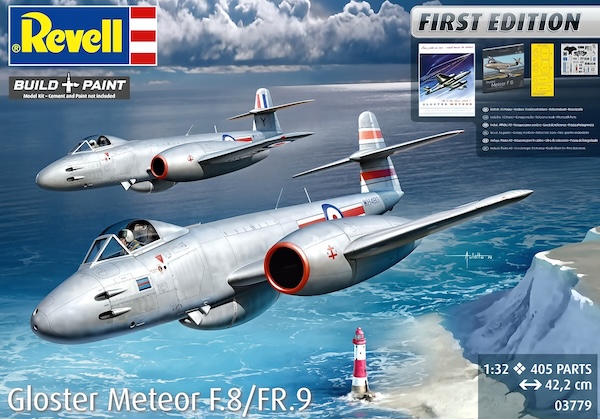
Look at our In-box full review of the Revell Gloster Meteor F8/FR.9 1:32
See all our Revell Finished Aircraft builds
Already a subscriber? Jump ahead to the main article.
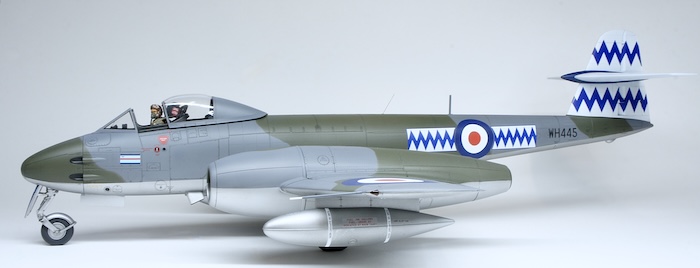
Just before we get on with this review here’s a look at the finished model just to let you see how it all turned out.
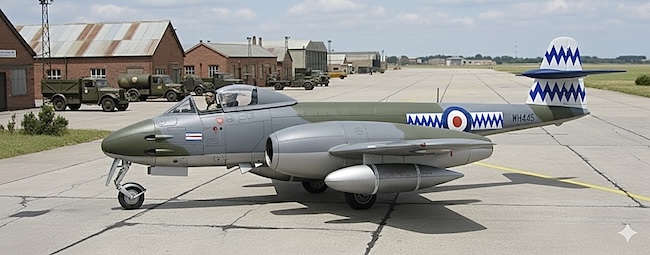
And an AI Created image for my finished model using Google Gemini…
Background
This is Revell’s new release (Dec 25) and a full in-box review can be found here. My plan was to try and build it from the box as much as I could with the exception of some alternative markings to that in the box, but more on that later.
A Short History of the Meteor F8/FR9
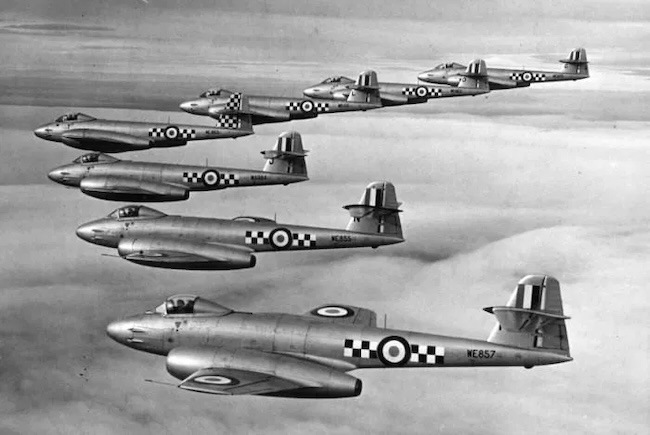
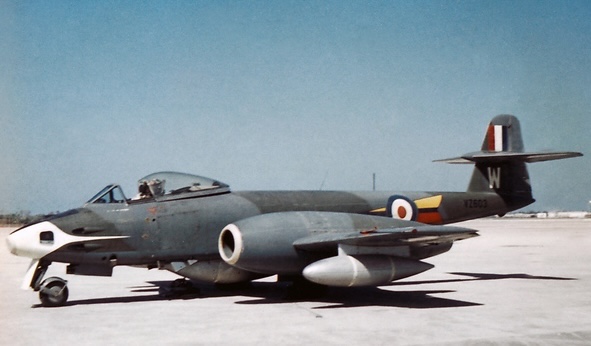
Gloster decided to modernise the F.4 while retaining as much of the manufacturing tooling from previous variants as possible. The result was the definitive production model, the Meteor F.8 (G-41-K), serving as a major RAF fighter until the introduction of the Hawker Hunter and the Supermarine Swift. The first prototype F.8 was a modified F.4, followed by a true prototype, VT150, that flew on 12 October 1948 at Moreton Valence. Flight testing of the F.8 prototype led to the discovery of an aerodynamic problem: after ammunition was expended, the aircraft became tail-heavy and unstable around the pitch axis due to the weight of fuel in fuselage tanks no longer being balanced by the ammunition. Gloster solved the problem by substituting the tail of the abortive G 42 single-engined jet fighter. The F.8 and other production variants successfully used the new tail design, giving the later Meteors a distinctive appearance, with taller straighter edges compared with the rounded tail of the F.4s and earlier marks.
The F.8 also featured a fuselage stretch of 76 cm, intended to shift the aircraft’s centre of gravity and also eliminate the use of ballast formerly necessary in earlier marks due to the subsequent elimination from the design of two of the originally designed six installed cannons. The F.8 incorporated uprated engines, Derwent 8s, with 3,600 lbf thrust each combined with structural strengthening, a Martin Baker ejection seat and a “blown” teardrop cockpit canopy that provided improved pilot visibility.
Between 1950 and 1955, the Meteor F.8 was the mainstay of RAF Fighter Command, and served with distinction in combat in Korea with the RAAF as well as operating with many air forces worldwide, although it was clear that the original design was obsolete compared with contemporary swept-wing fighters such as the North American F-86 Sabre and the Soviet MiG-15. The last Meteor F.8 left RAF frontline squadrons in 1957. Several F.8 were used for target towing or as aggressor until 1970.
Initial deliveries of the F.8 to the RAF were in August 1949, with the first squadron receiving its fighters in late 1950. Like the F.4, there were strong export sales of the F.8. Belgium ordered 240 aircraft, the majority assembled in The Netherlands by Fokker. The Netherlands had 160 F.8s, equipping seven squadrons until 1955. Denmark had 20, ordered in 1951, the last F.8s in front-line service in Europe. The RAAF ordered 94 F.8s, which served in the Korean War. Despite arms embargoes, both Syria and Egypt received F.8s from 1952, as did Israel, each using their Meteors during the Suez Crisis. Brazil ordered 60 new Meteor F.8s and 10 T.7 trainers in October 1952, paying with 15,000 tons of raw cotton.
In the 1950s, Meteors were developed into effective photo-reconnaissance, training and night fighter versions. The fighter reconnaissance (FR) versions were the first to be built, replacing the aging Spitfires and Mosquitos then in use. Two FR.5s were built on the F.4 body; one was used for nose section camera tests, the other broke up in mid-air while in testing over Moreton Valence. On 23 March 1950, the first FR.9 flew. Based on the F.8, it was 20 cm longer with a new nose incorporating a remote-control camera and window and was also fitted with additional external ventral and wing fuel tanks. Production of the FR.9 began in July. No. 208 Squadron, then based at Fayid, Egypt was the first to be upgraded followed by the 2nd Tactical Air Force in West Germany, No. 2 Squadron RAF at Bückeburg and No. 79 Squadron RAF at RAF Gutersloh flew the FR.9 from 1951 until 1956. In Aden, No. 8 Squadron RAF was given FR.9s in November 1958 and used them until 1961. Ecuador (12), Israel (7) and Syria (2) were foreign customers for the FR.9.
References:
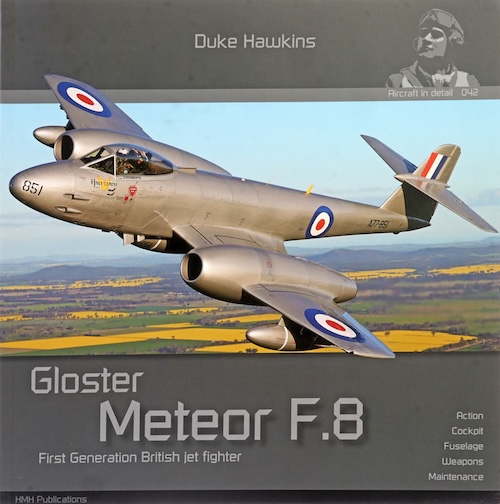
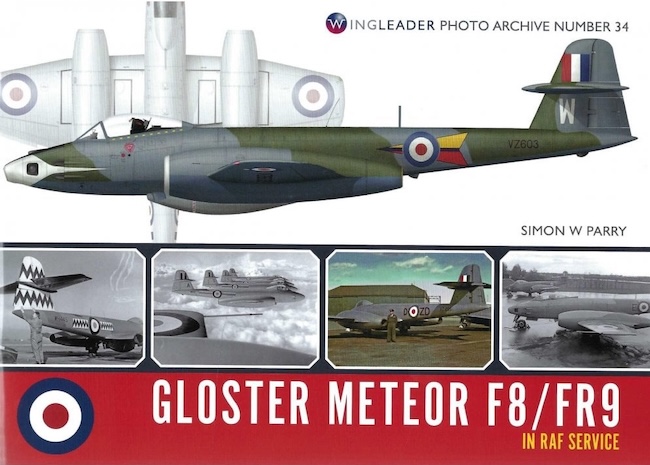
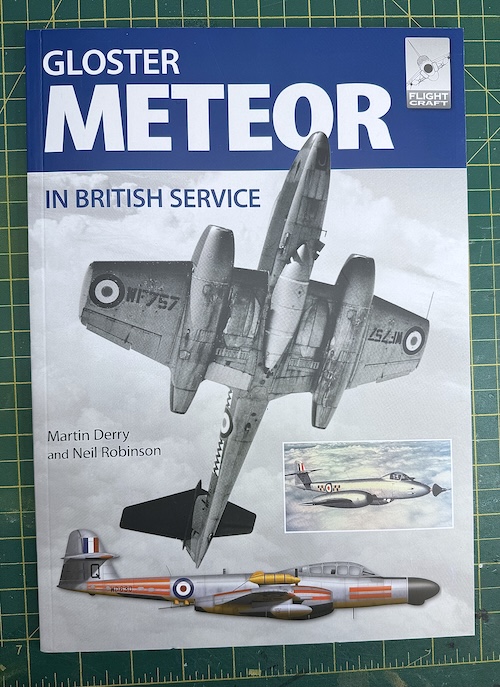
The following books were used as references – note the Duke Hawkins book is included in the initial ‘Special Edition’ boxing.
Construction…
Join the SMN Modelling Community Today
For just £1.50/month (£18/year), you’ll get:
✅ Unlimited access to 4,500+ in-depth build reviews
✅ Exclusive videos and how-to masterclasses
✅ New content added every week
✅ Cancel anytime
(That’s less than the cost of one paint pot per month!)