Short Feature Article with Rob Ruscoe
Just before we get started, here’s a quick look at how it all turned out…
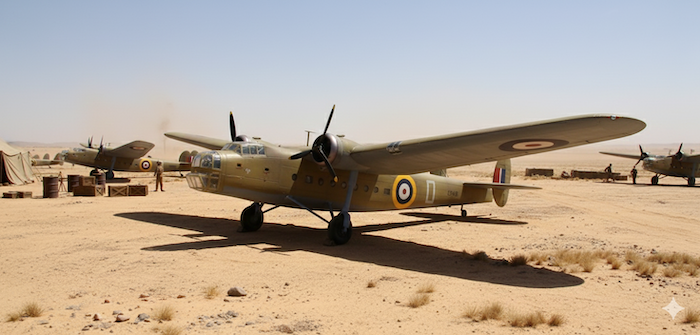
(Photo: Here’s my completed model centre shot. The image shows a background generated using AI software and looks pretty good I think)
After building two of the latest kits from ICM in the shape of the Henschel 123 and the Gotha 244, I now found myself with a couple of weeks spare awaiting their new Handley Page Hampden to arrive. ICM kits these days offer excellent engineering and fit and with the expectation that the Hampden would prove the same, I decided to refresh whatever modelling skills I may possess by delving into the stash for a more challenging build. I have already completed one Valom kit (NA B-45C Tornado) and remembered it provided the right sort of challenge I was looking for. Out of the stash came this kit of the Bristol Bombay.
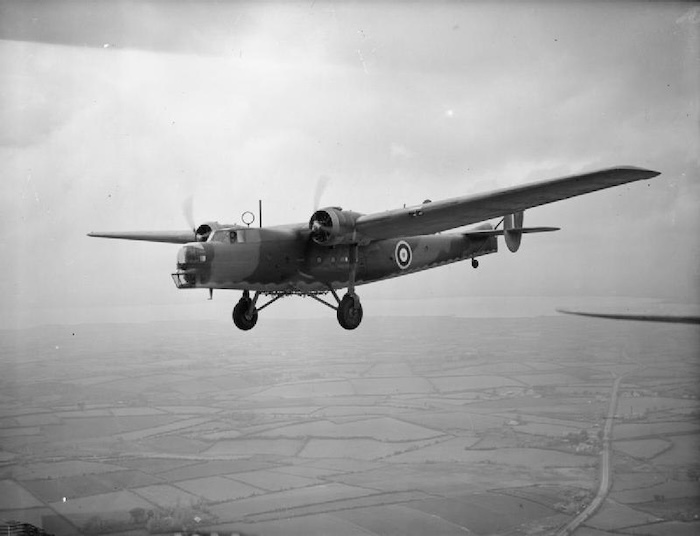
(Photo: Bombay Mark I, L5838, on a test flight from Aldergrove, County Antrim, before joining No. 216 Squadron in the Middle East. Courtesy IWM Collection)
Brief History
The Bristol Bombay arose from Air Ministry Specification C.26/31 which called for a monoplane replacement for the Vickers Valentia biplane in the Middle East and India. The aircraft was to fulfill a dual role of troop transport and bomber. The aircraft was of all-metal construction and after Bristol’s experience of wing twisting with their previous Bagshot, the wing design used no less than seven spars to provide torsional rigidity. The crew consisted of a pilot, a navigator/bomb aimer and a radio-operator/gunner who divided his time between his rear cabin position and a gun turret in the nose. An additional gunner could also be carried to man the tail position. Either 24 troops or 2000lb of bombs could be carried over ranges up to 1500nm.
The first production Bombay was delivered to 216 Squadron based in Egypt in September 1939. A few aircraft saw service with 271 Sqn ferrying supplies to the BEF in France in June 1940 but its main service was in the Middle East. When Italy entered the war in 1940, the Bombay was briefly used as a night bomber against targets in the Western desert until Vickers Wellingtons arrived to take over this task. The Bombay was then able to concentrate on transport operations and paratroop dropping duties. The most important operation in which the aircraft participated was the evacuation of over 2000 wounded Allied troops from Sicily to Italy in 1943. One crew was credited with carrying 6000 casualties from Sicily and Italy before the type was withdrawn from service in 1944.
On a personal note, my father, whilst serving with the Eighth Army in 1941, was flown by Bombay to Khartoum in Sedan. I don’t know from where he was flown as the annotation on the photo I have, does not include this. It is interesting to note that this particular aircraft appears to have the rear gun position painted over and this is reflected in my model.
The Kit
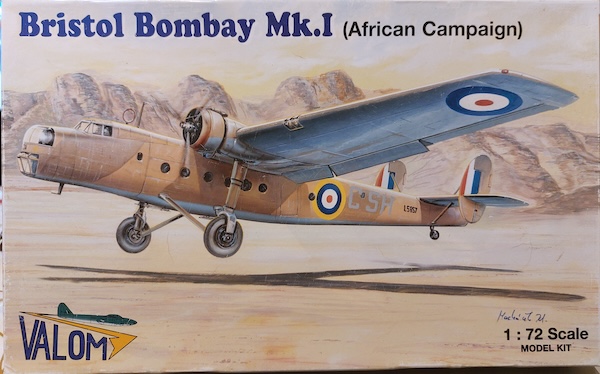
The kit comes in a sturdy box with some nice artwork of the aircraft about to touch down on a Desert strip. Inside are three styrene sprues of Valom’s usual tan coloured plastic along with two sprues of clear parts. A small zip lock bag contains the resin Pegasus engines and there is a single sheet of photo etch which includes seatbelts, instrument panel, pilot’s yoke and rudder pedals etc. A single decal sheet contains markings for two aircraft. The A5 instruction sheets are fairly basic but reasonably straightforward to follow with care.
The moulded surface detail is nicely done and looks to be accurate compared to the few photographs of the aircraft that exist on the net. Typically for a low pressure moulding, there is some flash clean-up required and of course, there are no locating pins present. The most significant feature of these kits is the rough joining surfaces of the major airframe components. These will need careful sanding to minimise join lines and to avoid copious amounts of filler. This emphasises the need with these limited run kits, to test fit and adjust before committing to cement.